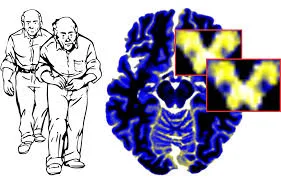
Parkinson’s Disease is an age-related chronic, progressive neurodegenerative disorder that primarily affects movement is the progressive loss of dopaminergic neurons in the substantia nigra pars compacta (midbrain). which is responsible for controlling movement and coordination. This condition is best known for how it affects muscle control, balance and movement, it can also cause a wide range of other effects on your senses, thinking ability, mental health and more..This leads to:
Formation of Lewy bodies, abnormal intracellular aggregates made of the protein alpha-synuclein, which are toxic to neurons.
Dopamine depletion in the striatum, a key component of the basal ganglia, which regulates voluntary motor control.
Parkinson’s disease
Major Pathological Processes:
Pathology
Mitochondrial dysfunction – Impaired complex I of ETC.
Protein aggregation – Due to dysfunctional autophagy and lysosomal path
What is the difference between Parkinson’s disease vs. parkinsonism?
“Parkinsonism” is an umbrella term that describes Parkinson’s disease and conditions with similar symptoms. It can refer not only to Parkinson’s disease but also to other conditions like multiple system atrophy or corticobasal degeneration.
Click on that to read more
Parkinson’s disease
Definition
A specific neurodegenerative disease caused primarily by dopamine deficiency in the substantia nigra.
Cause
Idiopathic (unknown exact cause), often linked to loss of dopaminergic neurons and Lewy body formation.
Underlying Pathology
Alpha-synuclein aggregation (Lewy bodies), dopamine neuron loss in substantia nigra.
Typically shows good improvement, especially early in disease.
Disease Progression
Slowly progressive, over many years.
Non-Motor Symptoms
Present (e.g., loss of smell, depression, REM sleep behavior disorder).
Examples
Idiopathic Parkinson’s Disease (only one type).
Neuroimaging
DaTscan: Decreased dopamine transporter uptake.
Treatment
Levodopa, dopamine agonists, MAO-B inhibitors, DBS in later stages.
Prognosis
Generally better, long-term management possible.
Parkinsonism (Parkinsonian Syndromes)
Definition
A broad clinical syndrome with signs similar to PD (e.g., tremor, rigidity), but can have many different causes.
Cause
Can be due to: <ul><li>Other neurodegenerative diseases (atypical Parkinsonism)</li><li>Medications (drug-induced)</li><li>Stroke, trauma, toxins</li></ul>
Underlying Pathology
Depends on cause: <ul><li>No Lewy bodies in drug-induced forms</li><li>Different proteinopathies in atypical types (e.g., tau in PSP)</li></ul>
Motor Symptoms
Similar motor signs, but often: <ul><li>More symmetric</li><li>More rapid progression</li><li>Less tremor</li></ul>
Response to Levodopa
Poor or minimal response in most forms of secondary or atypical Parkinsonism.
Disease Progression
Often faster progression (especially atypical forms like PSP or MSA).
Non-Motor Symptoms
May be less common or more rapidly developing cognitive/neurological issues.
My husband was diagnosed of Parkinsons disease 2 years ago, when he was 49. He had a stooped posture, tremors, right arm does not move and also a pulsating feeling in his body. He was placed on Senemet for 8 months and then Sifrol was introduced and replaced the Senemet, during this time span he was also diagnosed with dementia. He started having hallucinations, lost touch with reality. Suspecting it was the medication I took him off the Siferol (with the doctor’s knowledge) and started him on PD-5 natural herbal formula we ordered from AKNNI HERBAL CENTRE, his symptoms totally declined over a 3 weeks use of the AKANNI HERBAL Parkinson’s disease natural herbal formula. He is now almost 51 and doing very well, the disease is totally reversed! (Visit w w w.aknniherbscentre .com)
Suffering from Low back pain? Low back pain is the most common musculoskeletal issue that causes disability across all age groups. It is described as pain, stiffness, or tightness in the muscles above the gluteal Read more
Energy drinks have become one of the most widely consumed beverages worldwide, especially among young adults, athletes, students, and people with demanding work schedules. These drinks claim to boost energy, alertness, and mental performance. However, Read more
What Is the Influenza Virus? The influenza virus is an acute, highly contagious viral infection caused by viruses belonging to the Orthomyxoviridae family. It primarily affects the respiratory tract, including the nose, throat, and lungs, Read more


3 Comments
susan baker · July 22, 2025 at 11:47 pm
My husband was diagnosed of Parkinsons disease 2 years ago, when he was 49. He had a stooped posture, tremors, right arm does not move and also a pulsating feeling in his body. He was placed on Senemet for 8 months and then Sifrol was introduced and replaced the Senemet, during this time span he was also diagnosed with dementia. He started having hallucinations, lost touch with reality. Suspecting it was the medication I took him off the Siferol (with the doctor’s knowledge) and started him on PD-5 natural herbal formula we ordered from AKNNI HERBAL CENTRE, his symptoms totally declined over a 3 weeks use of the AKANNI HERBAL Parkinson’s disease natural herbal formula. He is now almost 51 and doing very well, the disease is totally reversed! (Visit w w w.aknniherbscentre .com)
bd7777bdt · July 19, 2026 at 1:57 am
Really enjoying the local feel of this site. The bonuses are generous and the registration process was a breeze. Cheers to bd7777bdt
Alzheimer's disease what is it, symptoms,causes and 7 preventive measures - Nutriphyfit · July 19, 2025 at 1:49 pm
[…] MUST READ – Parkinson’s disease: What it is, how to manage and 10 ways to prevent it. […]